

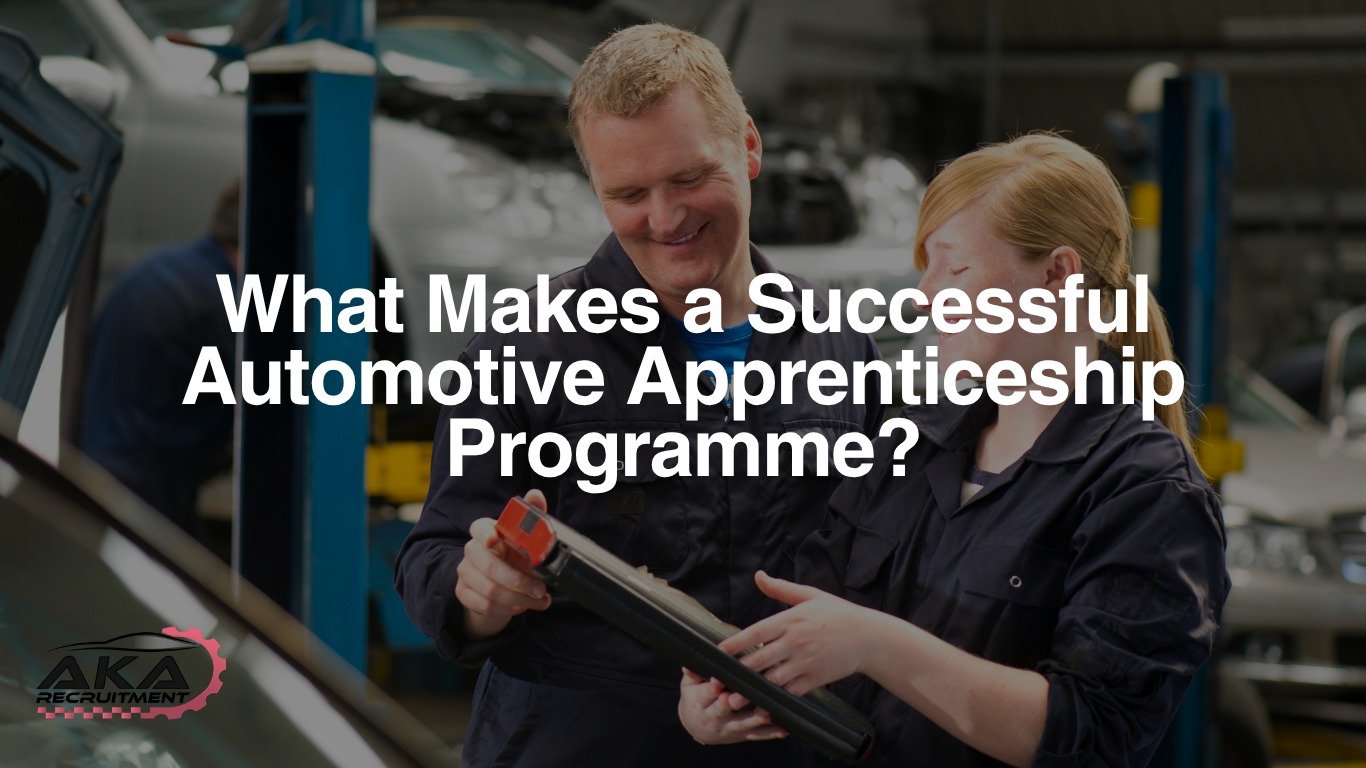
13 Nov What Makes a Successful Automotive Apprenticeship Programme?
A successful automotive apprenticeship does more than teach someone how to service a vehicle. It helps them build practical skills, confidence and a clear route into a lasting career, while giving a dealership or garage the chance to develop talent for its future needs.
That takes more than hiring an apprentice and handing them a toolbox. The strongest programmes combine structured training, supportive supervision and real workplace experience. Here’s what automotive employers should consider when building one.
Start with a clear role and realistic goals
Before advertising an automotive apprenticeship, decide what the apprentice will learn and where the role could lead. A programme might focus on training a Light Vehicle Technician—also known as a Vehicle Technician or light vehicle service technician—or a Diagnostic Technician, body repair technician or fast-fit (vehicle fitting) technician. Training could cover light vehicle maintenance, diagnostics, body repair, Engine Management, engine and exhaust systems, or air conditioning and electronics. The right choice depends on your workshop, the training available and the skills your business will need.
Apprenticeships can also lead to roles such as Parts Advisor, Retail Parts Advisor, Service Advisor or Customer Experience Specialist. For retail roles, a Level 2 Retailer Apprenticeship may be an option. Be clear about the day-to-day work, working hours, pay, training arrangements and progression opportunities. Make sure pay meets the applicable National Minimum Wage requirements. A realistic picture helps applicants decide whether the role suits them and gives your team a shared understanding of what success looks like.
Choose for potential, not just experience
An automotive apprenticeship is designed to develop skills, so applicants may have little or no workshop experience. Curiosity, reliability, communication and a willingness to learn can be just as important as existing technical knowledge.
During recruitment, look for people who ask questions, respond well to feedback and show care around safety. A structured interview or practical task can help you understand how a candidate thinks, without expecting them to perform like a qualified technician. For customer-facing roles, look for customer service skills alongside an interest in automotive parts or the wider customer experience.
Make workplace learning structured and hands-on
Apprentices need opportunities to apply what they learn in real working conditions and gain hands-on experience. Under the guidance of an experienced colleague, they might gradually build competence in workshop processes, routine servicing, fault-finding and customer care. Their responsibilities should grow as their skills and confidence develop.
A simple training plan can help track progress. Break larger skills into achievable steps, agree who will supervise each task and review what the apprentice has learned. This gives them a sense of direction and helps managers spot where extra practice is needed.
Give apprentices proper time for training
A busy workshop can make it tempting to prioritise immediate jobs over learning. But an automotive apprenticeship needs protected time for formal training as well as supervised practice at work.
Requirements depend on the apprenticeship standard, start date and UK nation. In England, the rules changed for starts from 1 August 2025: programmes must use the published minimum off-the-job training hours for the relevant standard, adjusted where prior learning applies. Employers should confirm current requirements with their training provider and make sure planned training time is delivered and recorded. (gov.uk)
Automotive apprenticeship routes and qualifications vary by role and location. A light vehicle pathway may include the Level 3 Motor Vehicle Service And Maintenance Technician (Light Vehicle) Apprenticeship Standard, also known as the Level 3 Service and Maintenance Light Vehicle Technician Apprenticeship. In Scotland, the relevant qualification may be at SCQF Level 5 or SCQF Level 6. Employers should check the current standard and recognised qualifications with their training provider or the Institute of the Motor Industry (IMI).
Pair the apprentice with a supportive mentor
A good mentor can make a major difference to an apprentice’s experience. They demonstrate safe working habits, explain why a task is done a certain way and create space for questions. Regular check-ins also make it easier to discuss progress, challenges and goals.
Mentoring should be part of the role, not an informal extra that disappears whenever the workshop gets busy. Give mentors time to support the apprentice, and make sure they know what the training plan requires.
Build safety and confidence together
Automotive workplaces involve tools, lifting equipment, moving vehicles and electrical systems. Apprentices should learn safe procedures before carrying out tasks, with supervision that matches their experience. They also need to know when to stop and ask for help.
As vehicles and workshop technology change, training should keep pace. Where a role involves electric or hybrid vehicles, make sure apprentices receive appropriate instruction and follow the relevant safety procedures before working on those systems. The aim is to build confidence without encouraging anyone to work beyond their competence.
Teach the skills customers and teams rely on
Technical ability is essential, but it is not the whole job. Automotive professionals also need to communicate clearly, work well with colleagues, follow instructions and take responsibility for the quality of their work.
Where appropriate, apprentices can learn how workshop teams communicate with service advisors, parts staff and customers. A Retail Parts Advisor Apprentice or Customer Experience Specialist Apprentice can also learn how their work supports the wider team. These experiences help apprentices understand how their work fits into the business, while building transferable skills they can use throughout their careers.
Review progress and plan what comes next
Regular reviews help apprentices see how far they have come and identify what they need to practise next. Involve the apprentice, their mentor and the training provider where appropriate. Set clear actions, then check whether the support and training are working.
Assessment arrangements are also changing in England, with revised approaches being introduced in stages. The approach that applies depends on the apprentice’s standard and programme, so employers should confirm the current assessment plan with their training provider. Whatever the format, preparation should be part of the learning journey, not a last-minute task. (gov.uk)
Think about progression before the apprenticeship ends. Discuss possible next steps, such as a permanent role, further technical development or a route into diagnostics, service advising or team leadership. A three-year Service Technician Apprenticeship Programme may suit some workshop roles, while others may lead to becoming a qualified Parts Advisor, vehicle mechanic or Vehicle body repairer. A degree in automotive engineering could be a further option for those who want to continue their studies. A clear future can help apprentices stay motivated and help employers retain skills they have invested in developing.
Create an environment where apprentices can thrive
A successful programme gives apprentices meaningful work, consistent support and room to learn from mistakes. It should welcome people from different backgrounds and make expectations clear from day one. When apprentices feel respected and included, they are more likely to ask questions, take feedback on board and become confident members of the team.
For automotive employers, apprenticeships are a long-term investment in people and capability. Whether you are recruiting through a national apprenticeship scheme or working with a local provider, a clear plan, strong mentoring and proper training time can help new talent grow while building a stronger workforce for the future.
AKA Recruitment supports employers across the automotive sector, from dealerships to local garages. Explore AKA’s automotive recruitment services or contact the team to discuss your recruitment needs.