

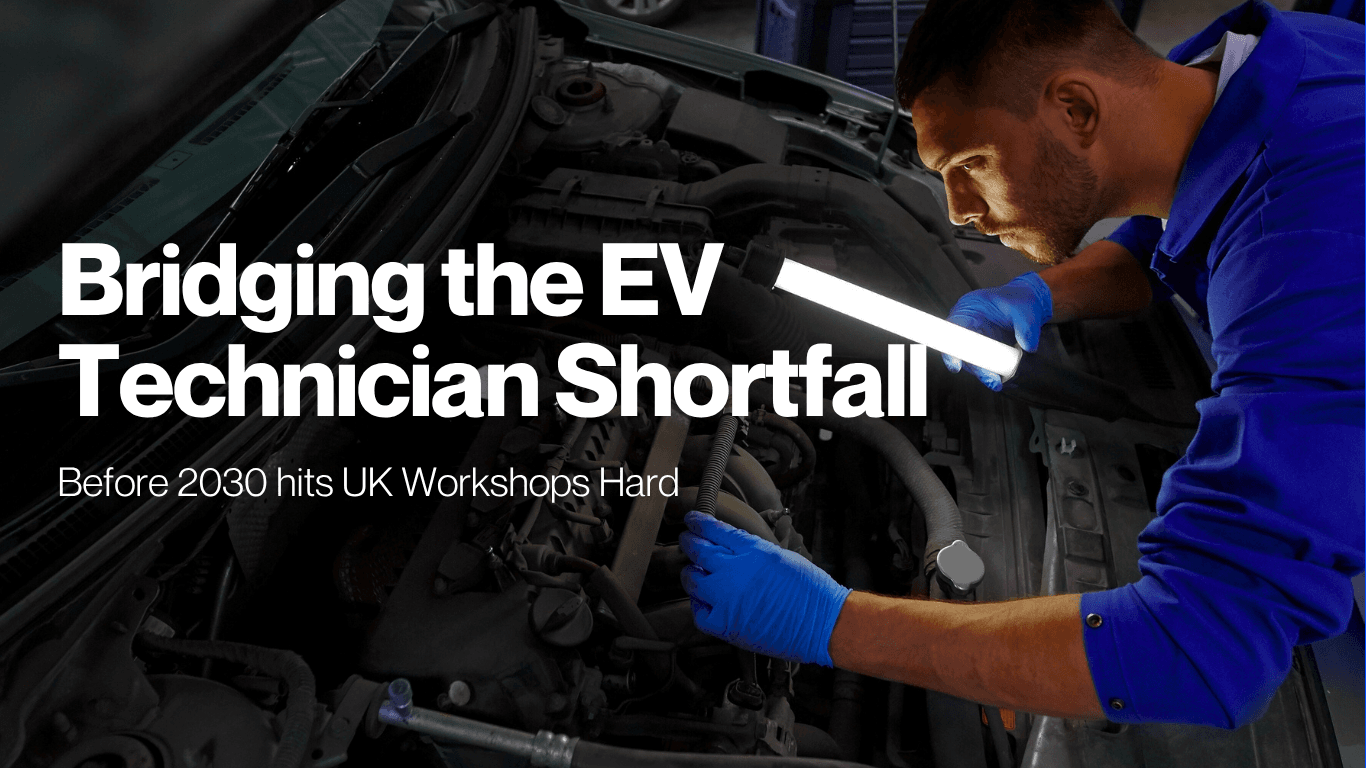
06 May Bridging the EV Technician Shortfall before 2030 hits UK Workshops Hard
Bridging the EV technician shortfall before 2030 hits UK workshops hard
The UK’s EV transition is accelerating, but the skills pipeline is not—especially across the wider UK automotive technician workforce.
The Institute of the Motor Industry (IMI) has warned that the country is on track for a 35,700-technician shortfall by 2030—at the same time as EV adoption and regulation demand more qualified people in bays, not fewer. (tide.theimi.org.uk)
If workshop leaders wait for “a clearer picture”, the clearer picture may arrive as empty ramps, longer lead times, and customers travelling further for a competent EV-safe repair—particularly as many more electric vehicles (and hybrids) enter the parc.
The headline numbers behind the warning
The IMI’s modelling is stark: around 90,000 technicians will be required to service the expected volume of zero-emission vehicles on UK roads by 2030—yet current trends still point to a sizeable gap. (tide.theimi.org.uk)
At the same time, near-term training momentum has cooled. By the end of Q3 2025, IMI data reported that only 26% of the technician workforce was EV qualified (71,942 technicians), and the number gaining an EV qualification in Q3 2025 fell by nearly 13% compared to Q1. (news.cvshow.com)
| Metric | What it suggests | Why it matters |
|---|---|---|
| 90,000 technicians needed by 2030 | Demand for EV-competent servicing capacity is rising fast | Without capacity, servicing becomes a bottleneck (tide.theimi.org.uk) |
| 35,700 shortfall by 2030 | Supply is not keeping pace | A national constraint, not just a “local hiring issue” (tide.theimi.org.uk) |
| 26% EV qualified by end of Q3 2025 (71,942 techs) | Most of the workforce still can’t safely take on many EV jobs | Creates a “postcode lottery” for EV drivers (news.cvshow.com) |
| EV qualification gains down nearly 13% in Q3 2025 vs Q1 | Training flow is slowing, not accelerating | The gap becomes harder (and costlier) to close (news.cvshow.com) |
When fewer technicians gain electric vehicle qualifications, workshops have to “route around” the problem:
- Jobs get reallocated to a smaller subset of EV-competent staff (often the same skilled technicians)
- Diagnostic and repair queues build for EV and hybrid work, including maintenance jobs that can’t be delayed
- Non-EV tasks are used to keep utilisation up, even when demand is shifting
In short: the workshop doesn’t stop being busy, but it becomes less efficient—even with a strong skilled workshop team.
And there’s a compounding effect. If EV-qualified technicians are overloaded, they are more likely to burn out or move—making the shortage feel worse even when overall headcount stays similar.
The ZEV mandate raises the stakes for aftersales capacity
The UK’s Zero Emission Vehicle (ZEV) mandate sets minimum targets for the share of new zero-emission cars and vans sold each year. The trajectory rises to 80% of new cars and 70% of new vans by 2030, on the pathway to 100% by 2035. (iea.org)
That means the car parc is going to skew increasingly electrified, quickly—and workshops will see more next-generation vehicles with complex electric vehicle systems alongside different advanced driver assistance systems.
If aftersales can’t keep up—especially in independent and regional markets—EV adoption faces an avoidable friction point: drivers hesitate when they aren’t confident they can get repairs done locally, safely, and promptly.
That hesitation increases when customers drive adas-equipped vehicles and hear about adas faults, adas sensors calibration delays, or a faulty advanced driver assistance system putting the vehicle into a restricted mode.
Retraining is the fastest lever—and the IMI is calling for funding
The IMI has repeated its call for a £15 million funding boost to support EV skills training, suggesting it could help contribute towards training up to 75,000 technicians. (tide.theimi.org.uk)
For many businesses, the barriers are not philosophical—they’re practical:
- training time vs ramp time
- cost of courses, equipment, and backfill (especially for live ev systems work)
- uncertainty on “which qualification, which level, and when”—including whether a recognised qualification is needed for specific job types
Funding reduces the financial drag, but employers still need a plan that protects throughput while upgrading capability—and while meeting remit training obligations.
What workshops can do now: a practical 2026–2030 action plan
Workshop resilience between now (March 2026) and 2030 will come down to a few disciplined moves—grounded in essential automotive knowledge and a clear understanding of what the right training course looks like for each technician.
1) Treat EV capability like capacity planning, not “training when quiet”
Training “when it’s quieter” often means training never happens.
Instead, plan EV upskilling as a capacity project with targets such as:
- % of technicians EV-qualified by quarter (e.g., starting from IMI Level 1 awareness through to higher-voltage competence, where appropriate)
- a named backfill plan for time off the tools
- a defined job mix that EV-trained technicians will own (including safe isolation, routine maintenance, and structured functioning testing)
This is where choosing between electric vehicle training courses, electric vehicle courses, and blended pathways (including hybrid IMI level options) matters—so you’re building the right skill-set rather than collecting certificates.
2) Build a two-speed team: upskill and hire in parallel
Upskilling the existing workforce is essential—but it’s rarely sufficient on its own.
To prevent bottlenecks, many businesses will need both:
- retraining pathways for loyal, high-potential technicians (including a hybrid vehicle bundle where hybrids remain a major part of the job mix)
- external hiring to add immediate EV capacity and mentorship bandwidth
This approach also helps cover adjacent skills that remain in high demand, such as vehicle air conditioning systems work, MOT training needs, and diagnosis across electrified platforms—without stretching your EV-qualified staff too thin.
3) Make retention part of the “skills strategy”
If you finally train someone and then lose them, you’ve funded your competitor’s capability.
Retention doesn’t always require a dramatic overhaul; it often comes down to basics done consistently: progression, fair workload distribution, and clear recognition for taking on high-voltage responsibility.
It also helps to be explicit about the path from early-stage EV qualification (or an entry ev qualification) to broader electric vehicle knowledge—so technicians can see how their significant core knowledge grows into safer, faster decision-making with cutting-edge technology.
How AKA Recruitment helps employers bridge the gap faster
At AKA Recruitment, we support workshops, dealer groups, and independents with recruitment built for speed, compliance, and long-term fit across the automotive industry.
We’ve been recruiting in the automotive sector since 2001, operating UK-wide and supporting both permanent and temporary hiring needs. (akarecruitment.co.uk)
If you need to stabilise ramp occupancy while you retrain, our process is designed to reduce hiring friction:
- Access to a large, active candidate network (including technician hiring) (akarecruitment.co.uk)
- Support services such as CV writing help, plus right-to-work and DBS checks to keep hiring compliant and smooth (akarecruitment.co.uk)
- Clear routes to engage: services, automotive recruitment, or contact AKA Recruitment (akarecruitment.co.uk)
We also see growing demand for structured pipelines—whether that’s an apprenticeship programme, opportunities for vehicle parts apprentices moving into workshop roles, or targeted hiring for adas-equipped vehicles where calibration and fault-finding are increasingly central.
A final word: 2030 is closer than the training cycle
Between Q3 2025’s certification slowdown and the 2030 ZEV trajectory, the direction of travel is clear: workshops that act early will protect productivity and customer confidence; those that wait will be hiring reactively, paying more, and still struggling to meet demand. (news.cvshow.com)
The most futureproof (“hybrid futureproof” as well as EV-ready) operators are treating training as a system: mapping electric vehicle qualifications to job types, validating competence, and ensuring coverage for hybrids, EVs, and ADAS—so the workshop can service the full range of vehicles coming through the door.
If you’re planning your EV capability roadmap—whether that’s hiring technicians now, building a training pipeline, or both—AKA Recruitment can help you bridge the gap with an efficient, straightforward recruitment process that keeps your workshop moving.